
Having just spent five days tasting, judging, and drinking mezcal in Puebla, Mexico – and yes, those are three different things – I have thoughts on the subject, some previously known but now reinforced, others somewhat revelatory. But first, a bit about mezcal.
For those unfamiliar with it, mezcal is similar to tequila, except with some pretty fundamental differences. To begin with, tequila may only be created in 181 municipalities scattered across five Mexican states, although the majority is distilled in Jalisco. Mezcal, on the other hand, may be made in all or part of twice that many states, most famously and prodigiously Oaxaca.
Secondly, while tequila production is limited by law to a single agave, the blue variety of Agave tequiliana Weber, usually shortened to blue or blue Weber agave, mezcal may be made from a wide variety of species of agave, up to fifty in total. Most common in mezcal production is espadín, known in Puebla as espadilla.
Still with me? Okay, here’s a bit more.
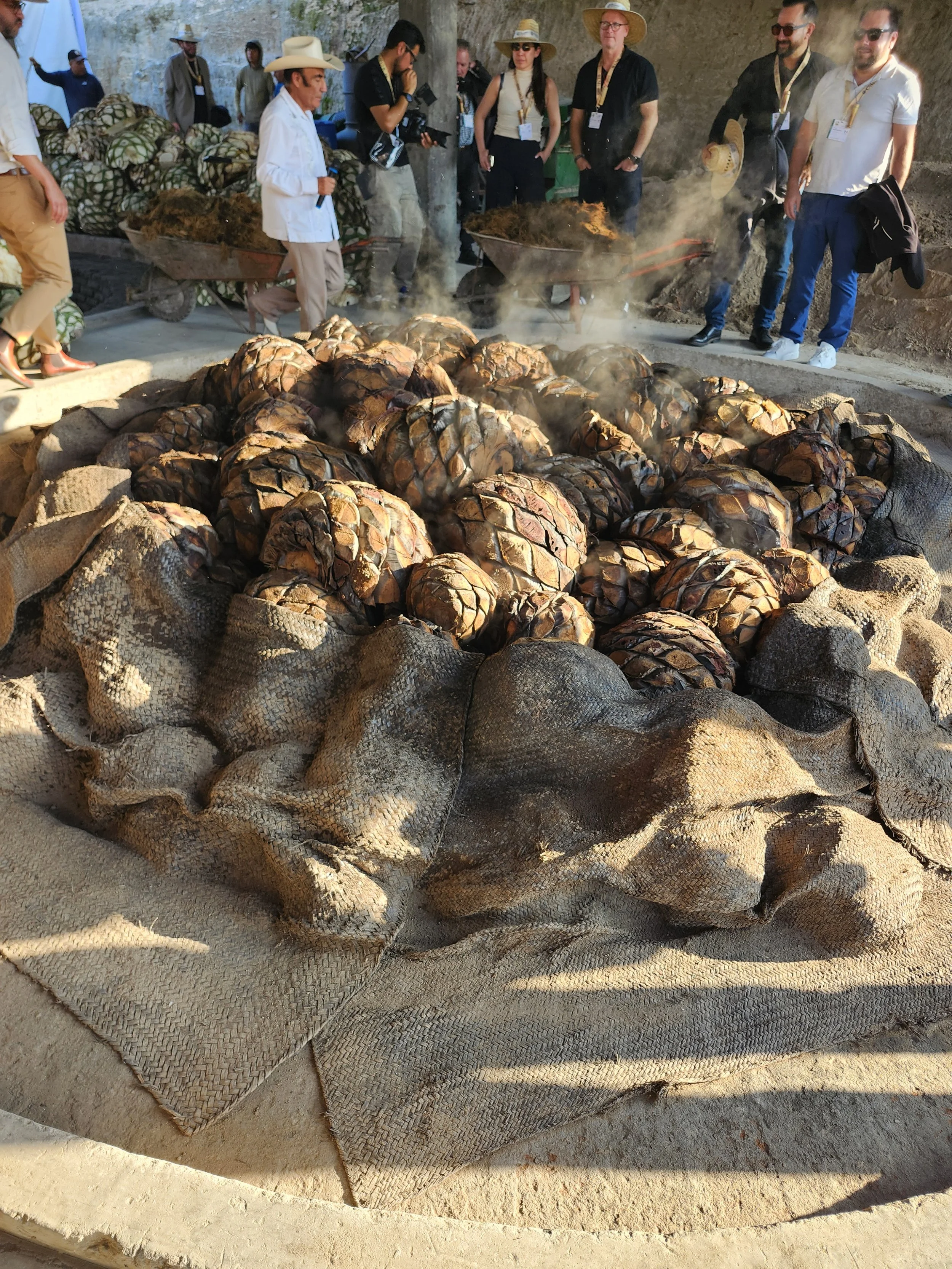
While most connoisseurs will only consider 100% blue agave tequila, a spirit may still be labelled tequila if it contains at least 51% agave, with the remaining alcohol derived from any manner of distillate, a type of spirit widely known as mixto tequilas. Additionally, tequila may exported in bulk for bottling elsewhere.
The vast majority of mezcal, on the other hand, is distilled from 100% agave and produced and bottle at the source, with bulk exports prohibited. Mixto mezcal does exist, but is rare and must be a minimum of 80% agave.
And now, some thoughts…
With all due respect to tequila and tequila producers, mezcal’s superpower is its ability to be made from any number of agaves, or even a bunch of different agaves put together. While geography, soil, and climate can and do make differences to the way a blue Weber shows in a tequila, mezcal may make use of all those factors plus the unique character of its source agave.
During my time in Puebla, I sampled mezcals made from numerous varieties of agave, including some ensamble mezcals distilled from multiple agaves. And while I will not claim to be expert enough to identify specific agaves by their taste, I will say that differences were notable, in some cases extraordinarily so.
Next, although it only received its official Denominación de Orígen, or DO, in 2016 – which is not to say that’s when the state’s distillers began producing the stuff, only that it is when they were officially sanctioned to use the word ‘mezcal’ on their labels – I was tremendously impressed by the general quality of what I tasted in Puebla. Together, they made a credible claim to the slogan I noted on a sign by the Rancho de Quillo booth at one of our mezcal tastings: “Oaxaca created the fame, Puebla perfected the elegance.”
I was also struck by the prevalence of women in the industry in Puebla, with most mescaleros still being male, but the faces of many of the distilleries being female. It reminded me of the number of top level women I noted at the rhum agricole distilleries of Martinique, and I think is a very good thing.
Finally, keep your eyes open for Puebla mezcals, which are presently very underrepresented in Canada but which, I believe, are about to be coming our way in greater abundance. The labels that stood out for me included the above-noted Rancho de Quillo, 14 Cerros, Incontrolable, Los Fuertes, Agavesos, Huichichiqui, Candinga, and El Gallo Mezcalero.