
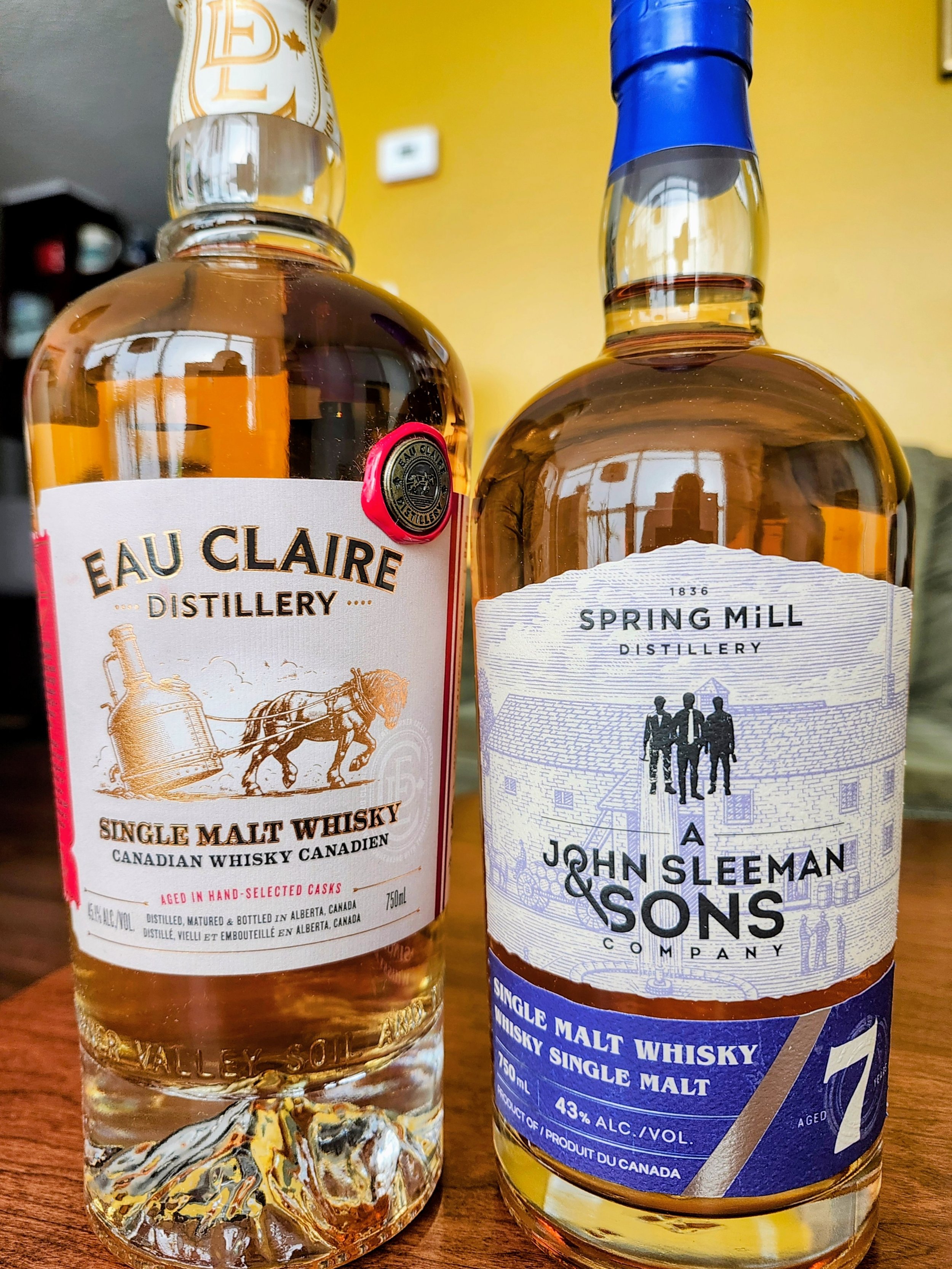
Can we talk a bit about age in whisky? Or more specifically, age in single malt whisky?
Back in the last century, when single malt was pretty much exclusive to Scotland – or at least they ‘owned the brand,’ as the marketers like to say – age statements were sacrosanct. The golden rule, consumers were regularly informed, was that the older the whisky, the better and more expensive it is. Twelve year old good, fifteen year old better, twenty-five year old best, and so on.
This remained the industry party line until the popularity of Scottish malts grew to the point that distilleries started to run low on their older whiskies, after which we were told by many producers, most famously The Macallan, that it wasn’t so much the age, but rather the blend of malts that was important.
Now, of course, everything has shifted back and extra-aged whiskies are all the rage not just in Scotland, but all around the world. (I have both an 18 and a 25 year old in the line-up for my Holiday Whisky tasting on November 27 at The Depanneur in Toronto!) As relative newcomers to the single malt category, however, Canadian distillers other than Glen Breton and, to a much lesser extent, Shelter Point are still fairly limited as to what age statements they can offer.
Thing is, it might not matter, or at least not matter that much.
Speaking as someone who has been sampling Canadian single malts from sea to sea to sea for several years now, I have become convinced that Canadian single malt whiskies tend to boast an aromatic and flavour maturity well beyond their stated age. Why this might be the case, I believe, has much to do with Canadian weather and its effect on warehoused whisky casks, and possibly also the high quality of Canadian malted barley.
Allow me to explain, addressing first the weather. Whisky matures not just by evaporating and concentrating over the years, but also by being drawn into the oak as it expands during the hotter months and expelled back when the wood contracts in colder times. The amount and degree to which this happens is shaped by weather patterns, which are far more extreme in Canada where southern Alberta, for example, can have an annual temperature variability of thirty-five to fifty degrees, including twenty or more degrees in a single week during a Chinook, as compared to the twenty degree range of Inverness in the Scottish Highlands.
That’s a lot of expanding and contracting, absorbing and expelling.
Then there is Canadian malted barley, which distiller after distiller has told me is among the very best in the world. For example, founder Graham Macaloney of British Columbia’s Macaloney’s Distillery has told me time and again that the late eminent Scottish whisky consultant, Dr. Jim Swan, told him not to worry about the lower yield he would get from Canadian as opposed to Scottish barley because it would pay off in the quality of the spirit. Others have related similar stories. Does that barley quality necessarily translate into better, younger single malts? More investigation is certainly merited, but my experience suggests it very much might.
All of which leads me to my review of two new single malt whiskies, one from southern Ontario and the other from southern Alberta, each at least seven years old.
John Sleeman & Sons 7 year old Single Malt
The first age statement whisky released by Sleeman & Sons, this has been matured primarily in ex-bourbon barrels save for one cask that had been last used for peated Islay whisky. Bright gold in colour, it has a soft, gently sweet nose with a faint hint of charred wood and smoke underlying caramel and vanilla notes. It’s a gentle aroma, not interested in announcing its presence with a holler, but rather in a series of ever more persuasive whispers, first vanilla, then a bit of oak and the faintest touch of campfire, light black licorice, fresh peach and dried apricot, and a finishing spritz of orange zest.
The palate belies its relative youth up front, with a sophisticated mix of vanilla and peach and cotton candy at the outset segueing to a drier, oakier mid-palate of dried stone fruit, raisin and brown spice, and cooked vanilla with a note of charred wood. The finish is when the rambunctiousness of this whisky begins to show, with a somewhat sharp alcohol presence and notes of peppery oak.
88 ($80)
Eau Claire Single Malt Whisky
While there is no age statement on the label of this new addition to the permanent Eau Claire portfolio, the back label declares that it is aged “for a minimum of 7 years in a combination of European oak #3 casks with toasted heads and ex-bourbon casks.” Also bright gold, it shows an even greater maturity than does the Sleeman & Sons in its aroma, with an enticingly complex mix of bready malt, a spiciness that hovers between nutmeg, cinnamon, and fennel seed, a waft of vanilla bean, buckwheat honey, and burnt citrus oil. To describe the nose as merely inviting is to do it a disservice; it’s positively compelling.
The flavour is similarly round and well-mannered, with a mellowness that suggests more a whisky in its teens than in single digits. The palate entry is silky, with mandarin orange and vanilla notable, almost evocative of a highbrow Creamsicle, while the main flavour is a soft and remarkably smooth mix of toffee, orange, nutmeg, oak, a bit of peppery spice, lime zest, and even a curious hint of kiwi fruit. The finish is just a shade on the sharp side, but still mellow well beyond its years.
91 ($80)
It deserves mention that while both of these whiskies are about the same age, Eau Claire has been at it for a fair bit longer, having launched their first product in 2014 and first single malt in 2017, as compared to John Sleeman & Sons which only opened in 2019. As good as each whisky is today, I suspect they will both only get better in the future.